
Silver-screen stars
From silent adventures to modern almost-silent cinema, these dogs made audiences lean in.
Rin Tin Tin
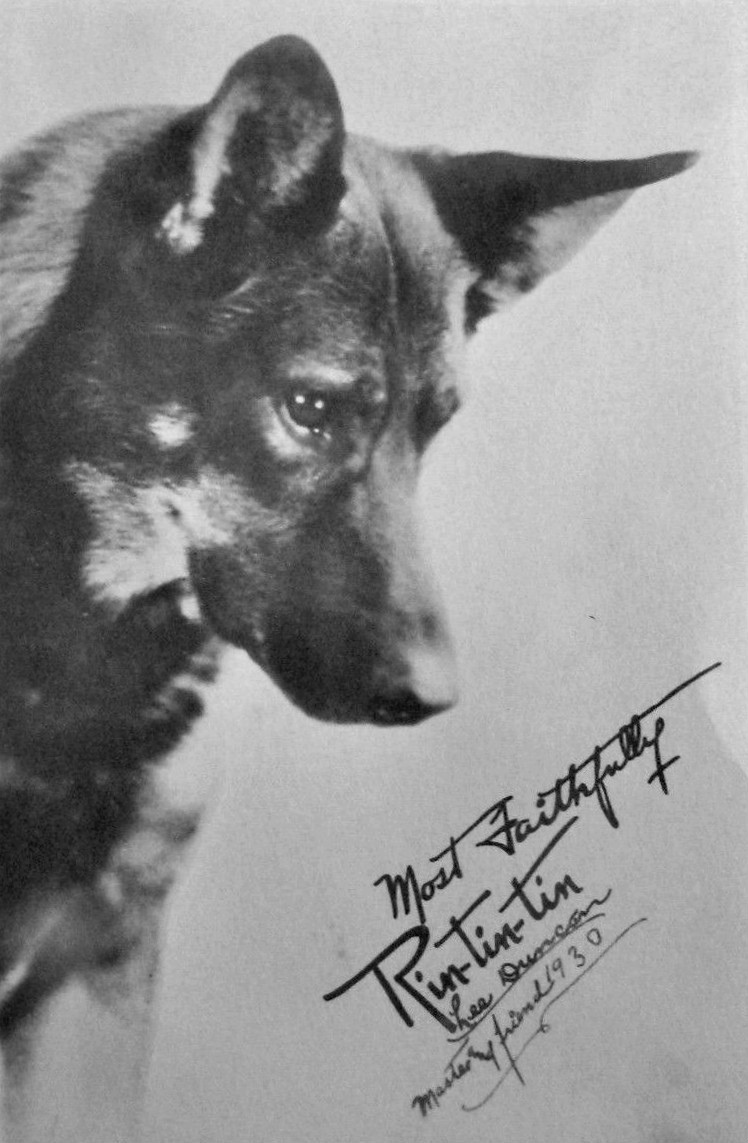
Credit: Chappel Bros. Inc., Rockford, Illinois (Ken-L Ration promotion), 1930; inscription includes owner/trainer Lee Duncan. Wikimedia Commons (US public domain).
Long before a dog could become famous in a fifteen-second video, a German Shepherd named Rin Tin Tin held an audience's attention without saying a word.
He came to the United States from France with Lee Duncan, a World War I veteran who became his trainer. Duncan's accounts of the dog's early life changed over time, so the most dramatic rescue versions deserve caution. His screen career is on firmer ground.
According to Stanford Humanities Center research, Rinty's first major role apparently came in The Man from Hell's River in 1922, after a Warner Bros. crew struggled with an uncooperative imitation "wolf." Duncan persuaded them to try his German Shepherd instead. The next year, Where the North Begins was a box-office hit, and the Stanford account says he went on to appear in 24 Warner Bros. features during the 1920s.
Silent film depended on visible expression. Adventure plots gave him doors to open and trails to follow. According to Duncan, his dark coat posed a filming challenge—and an ABC publicity sheet quoted in the Stanford research says the practical fix was talcum powder, so his face and body photographed more clearly.
One persistent tale says Rin Tin Tin won the popular vote for the first Best Actor Academy Award, only for officials to give the honor to a human. It is a delightful story. It is not true. Bruce Davis, a former Academy executive director, wrote in TheWrap that surviving ballots contradict the legend; a joke ballot connected with Jack Warner helped inspire the myth.
Rin Tin Tin died in 1932. Later dogs continued the name on screen, including the 1950s television series The Adventures of Rin Tin Tin. The Library of Congress added his 1925 film Clash of the Wolves to the National Film Registry in 2004.
Pal, the first screen Lassie
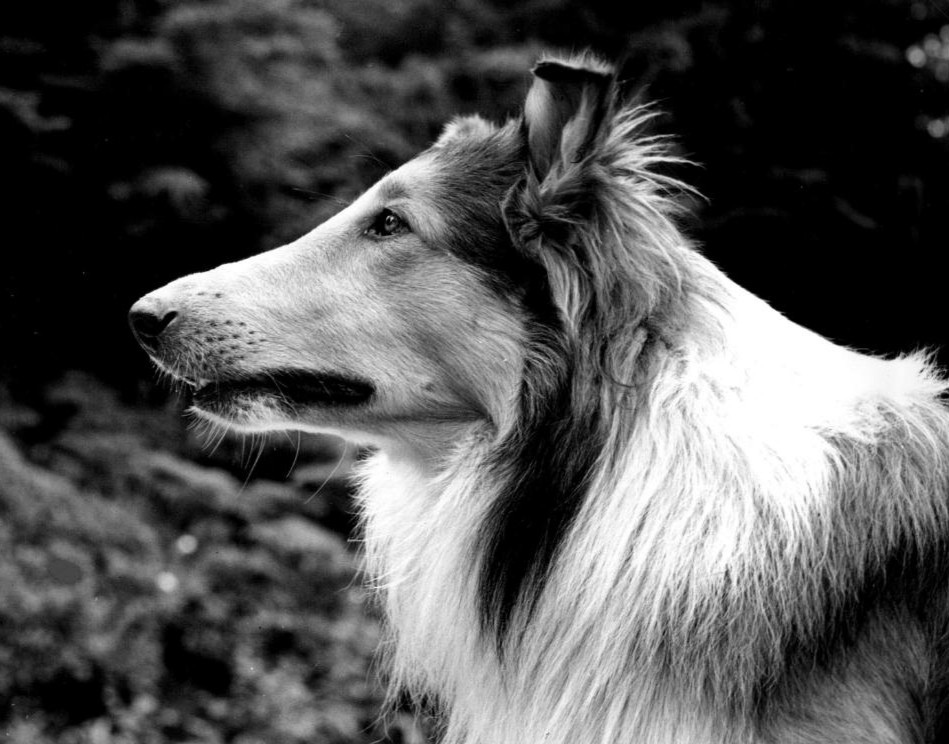
Credit: Photographer Dell Mulmey, Quinault, Washington. Wikimedia Commons (US public domain).
The first dog to play Lassie on the big screen was not named Lassie. He was not even female. He was Pal, a male Rough Collie handled by Hollywood trainer Rudd Weatherwax.
Before Hollywood, Eric Knight introduced Lassie in a Saturday Evening Post story in December 1938 and expanded it into a 1940 novel. In 1943's Lassie Come Home, Pal played the loyal collie who travels an enormous distance to return home. According to The Spokesman-Review's franchise history, Pal helped launch a remarkably durable screen family; later descendants continued the role.
Elizabeth Taylor, who starred in the film as a child, later described a mop-filled screen-test anecdote from the production. Pal himself was not part of that mop test—the story belongs to Taylor's recollection of the human audition process around the film.
Pal also performed Lassie on the radio, with barks, whines and pants carrying a character audiences already knew from the screen. Historical accounts reportedly put his weekly pay above many human supporting players of the era; the figures remain labeled "reportedly" rather than verified payroll.
The important distinction is the same one that follows other famous screen dogs: Lassie was the character. Pal was the working dog who first made her feel real.
Terry, the real Toto
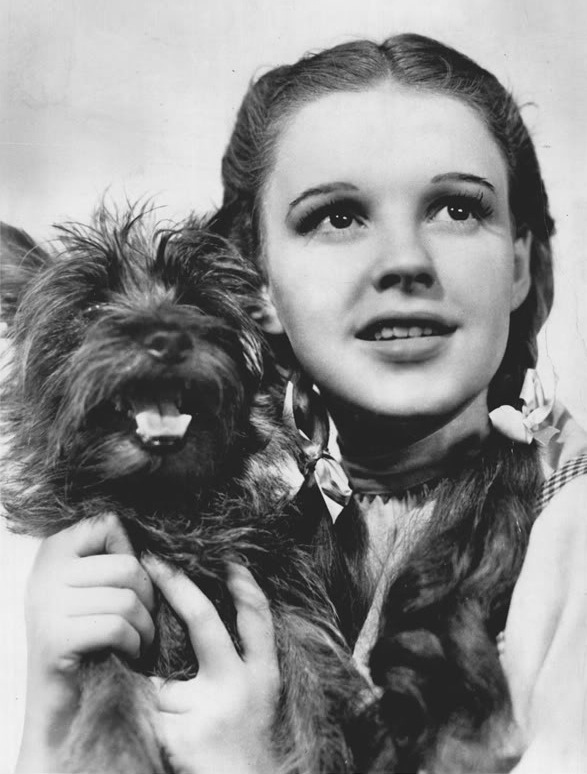
Credit: NBC Television Network, 1971. Wikimedia Commons (US public domain).
Toto may be small, but The Wizard of Oz would unfold differently without him. The dog inside that role was a female Cairn Terrier named Terry. She played the male Toto and later took the character's name offscreen.
NPR's history describes a one-year-old dog with housetraining trouble and so much anxiety that she spent much of her first three weeks hiding under her foster family's bed. She learned with trainer Carl Spitz, who prepared her for sitting, barking and chasing witches. MGM producer Mervyn LeRoy was auditioning roughly 100 dogs each week for Toto, according to NPR; Terry stood out partly because she resembled the dog in L. Frank Baum's illustrations and partly because she was ready for the work.
On set, NPR reports that Terry initially struggled with wind machines and learned to hide behind other actors when they started. During a rehearsal, one of the Wicked Witch's soldiers accidentally stepped on her. NPR says the accident sprained her paw—some later retellings say a fracture, but the safer sourced detail is the sprain. Spitz found a stand-in while she recovered; she returned after a few weeks.
Terry earned $125 per week on the film, according to NPR, more than many human performers in that 1930s context. After the 1939 premiere she was rechristened Toto, appeared in additional films and made public appearances. NPR credits her with 17 feature films. Her death year is omitted here because retrieved references disagree (1944 versus 1945), and the film story does not need it.
Higgins, the original Benji
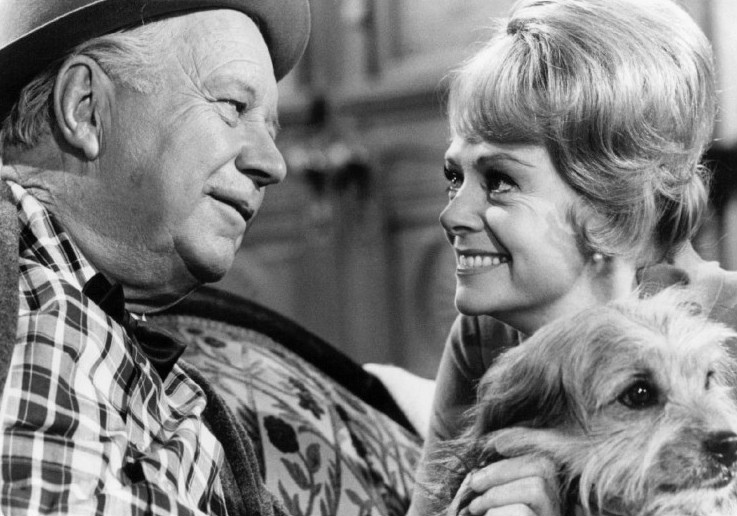
Credit: CBS Television, September 1969. Wikimedia Commons (US public domain).
Before Benji was a familiar movie name, he was a honey-brown mixed-breed dog named Higgins at a California animal shelter.
Trainer Frank Inn took him home in 1960 after an animal-control officer called about a part-terrier dog at a Burbank shelter, according to the Los Angeles Times' Inn obituary. Higgins went on to television—including Petticoat Junction—retired, and then returned for the role that made him famous: the resourceful stray in 1974's Benji.
HISTORY notes the film's debut and the character's lasting popularity. Later Benji films did not star Higgins himself. His daughter Benjean took over the role in follow-ups, including For the Love of Benji, Oh! Heavenly Dog and Benji the Hunted. Keeping those names straight matters: shelter origin, television work and the 1974 film belong to Higgins; later screen Benjis were other dogs in the same lineage.
Inn's Television Academy interview describes a training philosophy built around education, time and knowing an animal well. Years of companionship and work sat between the shelter and the spotlight—not an overnight discovery story.
Higgins's story is not a promise that every shelter adoption leads to a movie career. It is a reminder that an overlooked dog can still become someone's whole world—and, once in a while, a character audiences remember.
Uggie of The Artist
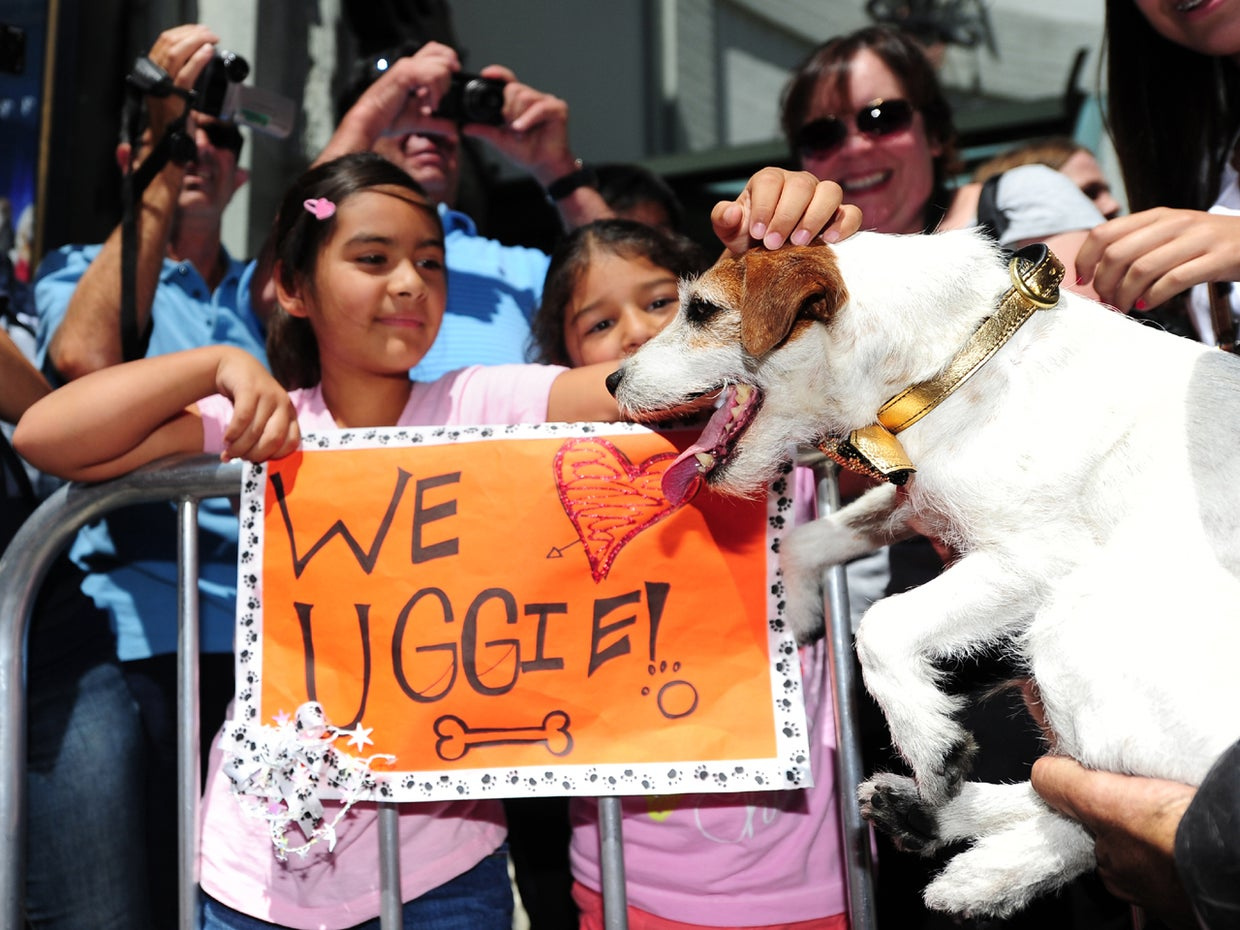
Credit: ROBYN BECK/AFP/Getty Images via CBS News; Grauman's Chinese Theatre, Hollywood, June 25, 2012. Source: CBS News.
Some stars make an entrance. Uggie arrived at his Hollywood retirement ceremony on a fire truck, wearing a golden bow-tie collar.
The Jack Russell Terrier charmed audiences in the mostly silent 2011 film The Artist, received the Palm Dog at Cannes and became the first dog to leave paw prints in cement outside Grauman's Chinese Theatre, according to the BBC. That courtyard honor should not be confused with the Hollywood Walk of Fame, where Lassie, Rin Tin Tin and Strongheart have stars.
The Guardian reports that Uggie's first two owners rejected him for being too lively, and that he was headed toward a pound when trainer Omar Von Muller took him in. Von Muller initially intended to foster him, then noticed how intelligent and bold he was and decided to train him instead. In The Artist, Uggie played the companion of George Valentin (Jean Dujardin), helping carry emotion without dialogue.
His June 2012 retirement event included water, treats, a fire-hydrant-shaped cake and an inky paw "autograph" on copies of The Artist. Von Muller encouraged people to consider adoption: a dog need not reach a theater to be the star of a home. Uggie had also appeared in Water for Elephants. The BBC reports he died in 2015 at age 13 after a cancerous prostate tumor.
Commercial stars
A few dogs became household faces from living rooms across America—no studio feature required, just a thirty-second spot and a line nobody forgot.
Gidget, the Taco Bell Chihuahua
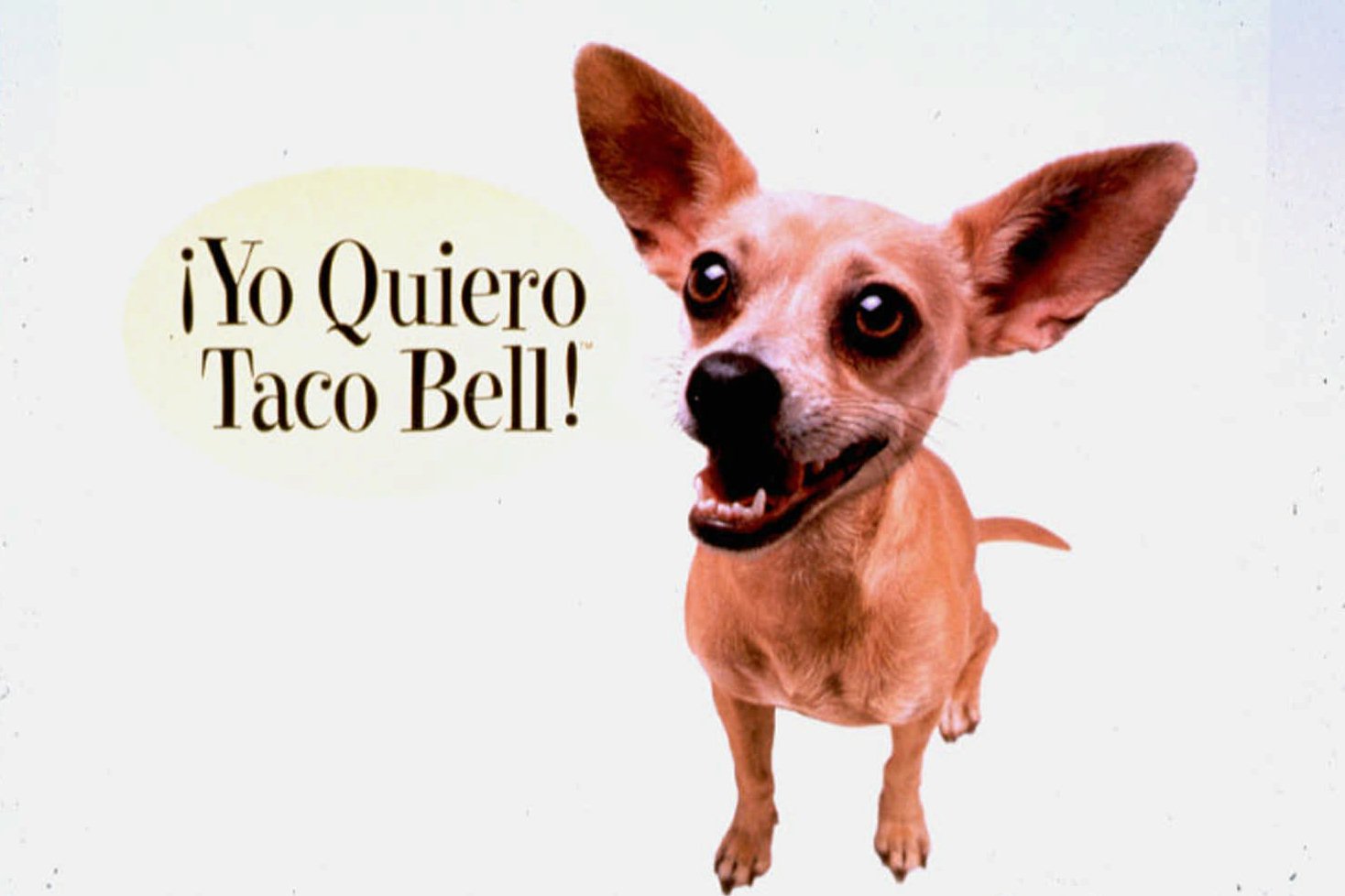
Credit: AP Photo/Taco Bell, HO. Source: The Spokesman-Review.
Long before a dog could go viral on a phone, a small Chihuahua named Gidget went viral on television.
She was female. In the ads, she played a male dog. Through special effects and a dubbed voice, Associated Press reporting recalls, she delivered the line that stuck in a generation's heads: "Yo quiero Taco Bell"—Spanish for "I want Taco Bell." Voice actor Carlos Alazraqui supplied the richly accented delivery.
What was supposed to be a single 1997 commercial became a campaign that ran from 1997 to 2000, according to the AP. Other Chihuahuas had bit parts; Gidget, said Studio Animal Services owner Karin McElhatton, was the one who got the close-ups and the quips. McElhatton's company owned the dog. Gidget lived with trainer Sue Chipperton and, by McElhatton's account, knew when the camera was on.
The ads made the mascot wildly popular. They also drew criticism from activists who said the campaign promoted Hispanic stereotypes—a dispute about the advertising, not about the little dog doing her job.
After the campaign, Gidget kept working. The AP notes a 2002 GEICO commercial and a role in the 2003 film Legally Blonde 2: Red, White & Blonde. The Los Angeles Times, citing People Pets, identifies that film role as Bruiser's mother—the Chihuahua mom opposite Reese Witherspoon's on-screen companion.
In July 2009, at age 15, Gidget suffered a massive stroke at Chipperton's home in Santa Clarita, California, and was euthanized, McElhatton told the AP. She had been hard of hearing but was otherwise described as healthy and retired—"lived like a queen," McElhatton said—until that final night.
Gidget's story sits beside Terry and Pal in one useful way: the character audiences remembered was not always the same gender, or even the same name, as the real dog who did the work.
White House and campaign dogs
Not every famous presidential-era dog lived in the White House. One became famous in a campaign speech; another became First Dog.
Checkers and the Nixon family
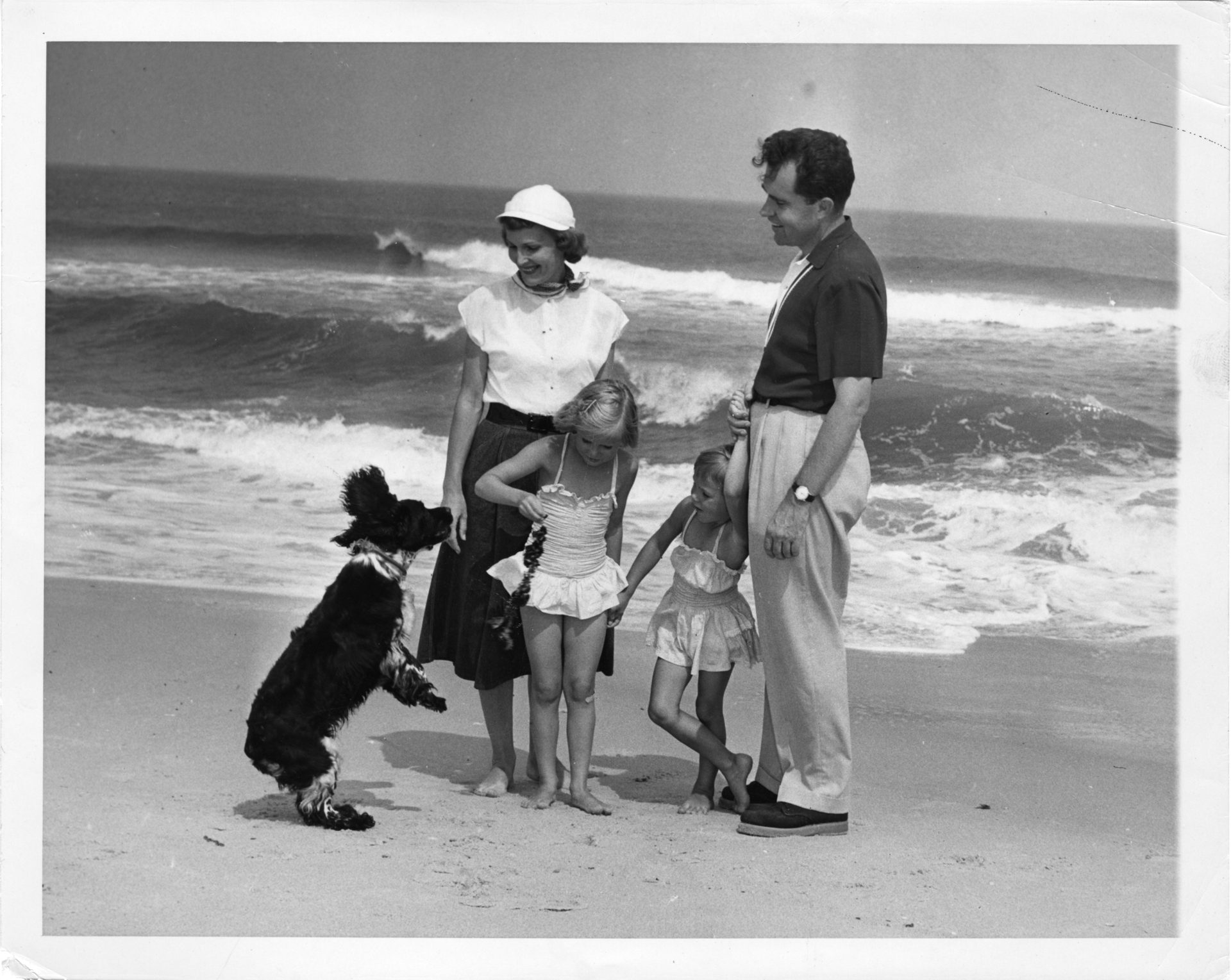
Credit: Richard Nixon Library & Birthplace / National Archives (via DPLA); original AP Wirephoto.
A puppy waiting at a train station probably had no idea a national television audience was about to hear that name.
Checkers was the Nixon family's black-and-white Cocker Spaniel. On September 23, 1952, then-Senator Richard Nixon described the puppy near the end of a campaign address later nicknamed the Checkers speech. PBS publishes the full transcript.
According to that account, a man in Texas heard Pat Nixon mention on the radio that the couple's daughters would like a dog. At Union Station in Baltimore, the family collected a crate from Texas containing a spotted Cocker Spaniel puppy. Six-year-old Tricia Nixon named him Checkers.
The broadcast dealt with questions over an $18,000 fund from supporters. Nixon argued the money paid political expenses, not personal use. Checkers was one gift he acknowledged—not a puppy associated with the disputed fund. After detailing finances, he said the family would keep the dog "regardless of what they say about it."
Checkers was a family dog during the 1952 campaign story, not a White House First Dog. He died in 1964; conflicting reports of his exact age (12 versus 13) are omitted here. The Presidential Pet Museum notes he remains among the best-known presidential-adjacent dogs never to live in the White House.
Bo Obama, First Dog
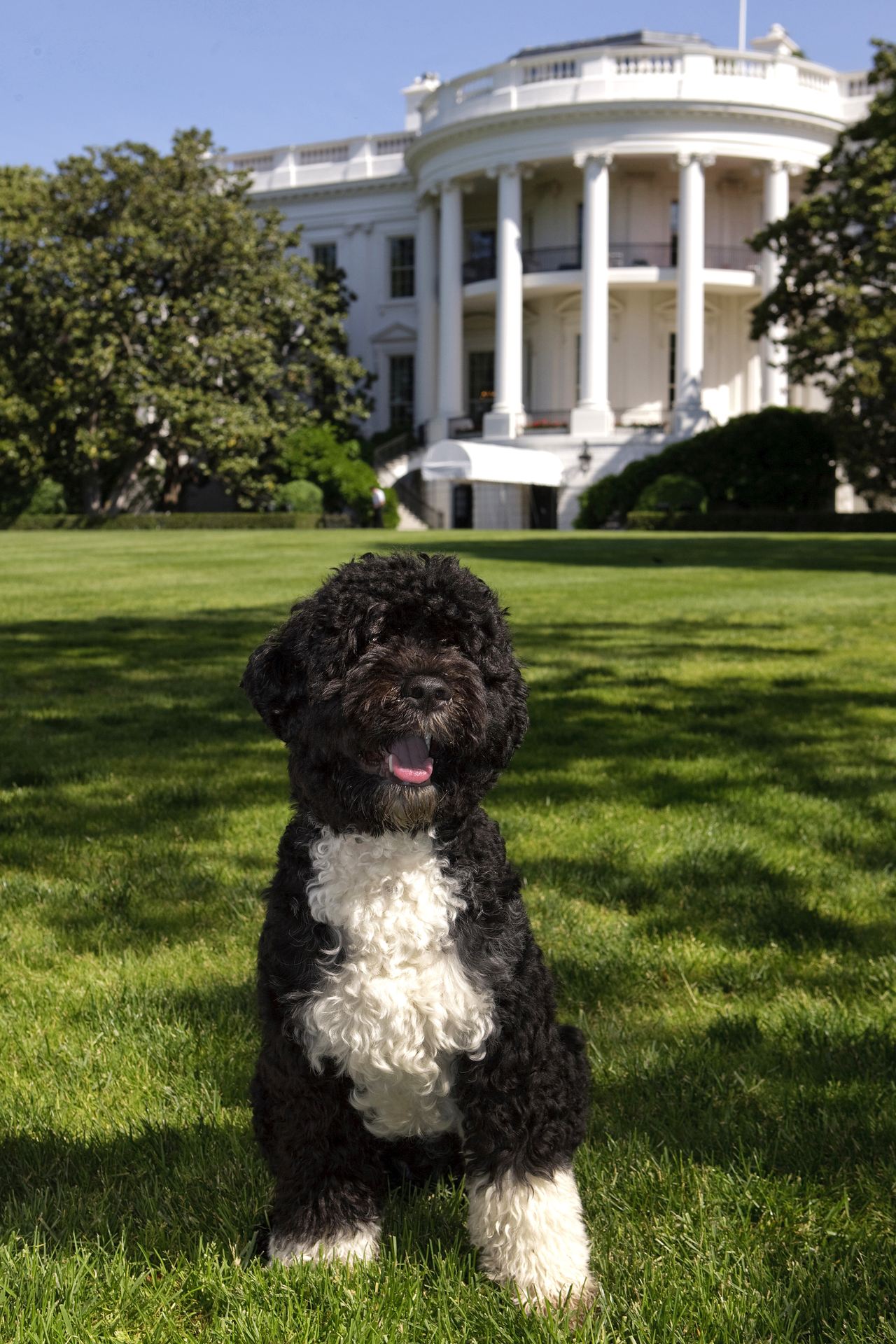
Credit: Chuck Kennedy, official White House photo (P052009CK-0015). US federal government work / public domain.
In the spring of 2009, a six-month-old Portuguese Water Dog walked into one of the most recognizable homes in the world.
His name was Bo. He is sometimes described as a shelter rescue. He was not. An Associated Press account explains the specifics: his first home did not work out; he was returned to his breeder in early March 2009; Senator Edward Kennedy and his wife, Victoria, offered him as a gift to Sasha and Malia Obama. Before the White House, he spent nearly a month with the Kennedys' dog trainer in Virginia.
The archived White House introduction from April 12, 2009 keeps it official: Bo was a boy, a six-month-old Portuguese Water Dog and a gift from Senator and Mrs. Kennedy. Breeders who had also bred the Kennedys' dogs named Bo's litter Hope and Change; one litter-mate joined Senator Kennedy's household.
An animal-welfare leader quoted by the AP called him a "quasi-rescue" because his first placement failed. The breeder did not consider him a rescue, and he never spent time in a shelter. The family's search had been complicated by Malia's allergies; the AP's breed discussion notes Portuguese Water Dogs' energy and coat care without promising any coat is allergy-proof.
Bo appeared in family photographs, portraits and holiday materials throughout the Obama years, including the Library of Congress-preserved 2012 "Bo Ho Ho" holiday features. The Obama Presidential Library later announced his death. No White House or Obama endorsement is implied by telling his story.
Internet-famous dogs
When sharing a photo took one tap, a few dogs became household faces without a studio lot.
Boo, an early internet dog star

Credit: Facebook/Boo via Yahoo Lifestyle Australia. Source: Yahoo Lifestyle Australia.
For a while, one small Pomeranian seemed to be everywhere online. With his round teddy-bear haircut, Boo became widely known by the catchy nickname "the world's cutest dog"—an affectionate brand, not an objective worldwide ranking.
Business Insider revealed in August 2012 that Boo belonged to Irene Ahn, then a finance lead at Facebook. She had used the name J. H. Lee for Boo-related work. Ahn created Boo's Facebook page in 2009; she told Time it began as a joke for friends who liked his photos.
A publisher approached when he had about 60,000 Facebook fans, according to Business Insider's interview with book publicist April Whitney. By August 2012, Boo's first book had been published in ten languages. A second book, centered on Boo and his dog friend Buddy, was on the way. Those 60,000 fans are a dated threshold, not a claim about later reach.
The BBC reported that Boo and Buddy lived together for 11 years. Buddy died in 2017 at age 14. On January 19, 2019, Boo's family announced that Boo had died in his sleep at age 12. His family's statement spoke about the dogs' bond and messages from people who said Boo had brightened difficult days. No medical "broken heart" conclusion is treated as fact here.
Jiffpom and two unusual walking records
Credit: Guinness World Records, official record-announcement image, 2014. Source: Guinness World Records.
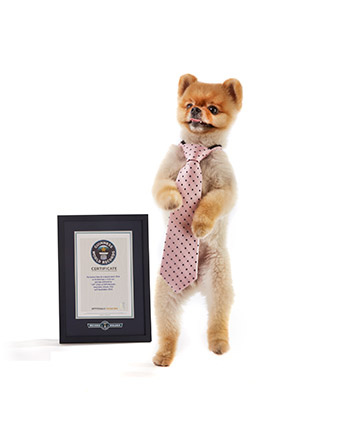
A tiny dog walks toward you on his hind legs. Then he switches to his front paws. That was Jiff, a Pomeranian from Los Angeles also known as Jiffpom.
Guinness World Records announced his achievements on August 27, 2014: 10 meters on his hind legs in 6.56 seconds and 5 meters on his front paws in 7.76 seconds. Both were new Guinness records at the time, and according to the announcement each successful performance came on his first record attempt. His repertoire also included bowing, skateboarding and stamping his own autograph.
He does not still hold every title from that announcement. Guinness announced in 2015 that Konjo had completed the 5-meter front-paw distance in 2.39 seconds, surpassing Jiff's mark. This profile does not claim current records, health status or audience totals.
Jiff and Jiffpom are the same dog—the longer name became the familiar online handle. The owners stayed largely anonymous in the 2014 Guinness coverage, keeping the focus on the performances rather than a human celebrity brand.
Unusual records can make a small dog look like a novelty act. The clearer takeaway is simpler: patient training, clear cues and a dog who enjoys the work can produce moments that still surprise people years later.
Doug the Pug
Credit: Caitlinfoley93 / Wikimedia Commons, own work. Creative Commons Attribution–ShareAlike 4.0 International (https://creativecommons.org/licenses/by-sa/4.0/).
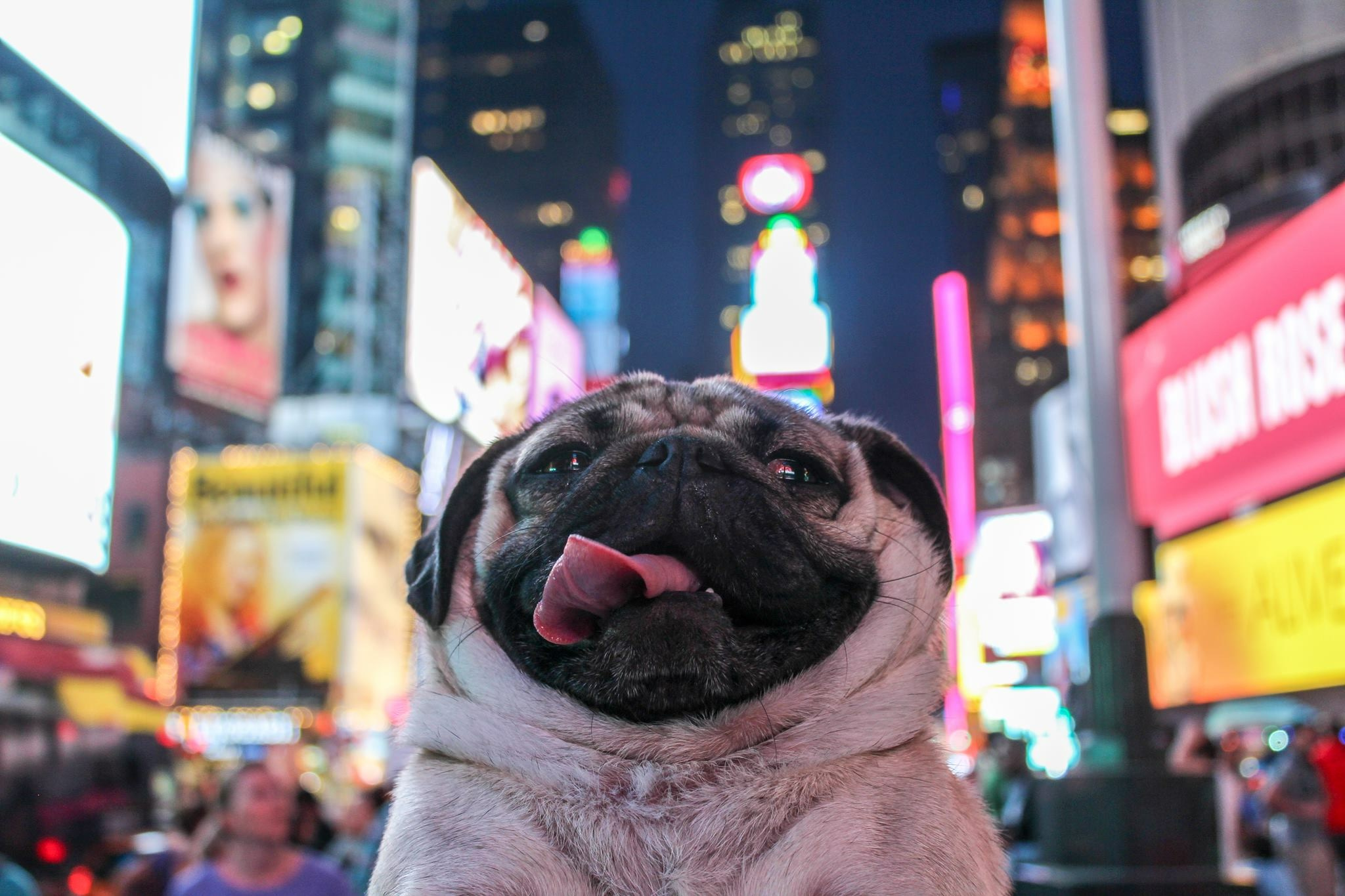
Every celebrity dog has an origin story. Doug the Pug's begins with a teenager taping pictures of pugs to her mother's bathroom mirror.
Leslie Mosier was 13 and hoping to persuade her family to get a pug. She already had a name picked out: Doug. The pictures did not immediately produce a puppy, but the name stayed. In the summer of 2012, she finally brought Doug home. USA TODAY reported her account in 2019.
Doug got his own Instagram account in 2014. A costume video featuring a pug-shaped balloon helped push him into wider view; USA TODAY noted about 21 million Facebook views for that video by 2019. Those figures are dated to the 2019 source, not refreshed as current totals.
He later contributed authentic pug sounds—every bark and snore—as Monchi in the animated film The Mitchells vs. the Machines (also discussed under the working title Connected), according to Animation Magazine and People. Costume and meme work are different from that genuine vocal contribution; no partnership or endorsement with Hooman on Demand is implied.
Doug's story is a historical profile of how a childhood name idea became a recognizable internet pug—not a statement about his current health or account activity.
Every dog deserves a little star treatment
Your dog may never chase a witch, keep a campaign gift or stamp an autograph. Still, the expressions you notice on a walk—the ear turn, the pause, the preferred sniffing spot—are the same kind of attention that made audiences fall for these famous dogs.
At Hooman on Demand in Raleigh, we treat every dog as the main character at home: walks and daytime pet sitting with the schedule you choose, and another walker ready if someone is out.
Book your free meet & greet so we can get acquainted.
Quick answers
Frequently asked questions
Did Rin Tin Tin win the first Best Actor Oscar?
No. Surviving ballots contradict the popular-vote story. A joke ballot connected with Jack Warner helped inspire the myth.
Was the original screen Lassie a female dog?
No. Pal, the first dog to play Lassie on screen, was a male Rough Collie. Lassie was the character.
Was Bo Obama a shelter rescue?
No. He was rehomed after a first placement did not fit, then given to the Obama daughters by Senator Edward Kennedy and Victoria Kennedy. He did not come from a shelter.
Was Checkers a White House dog?
No. Checkers was the Nixon family dog made famous in the 1952 campaign speech. He did not live in the White House as First Dog.
Does Jiffpom still hold both 2014 walking records?
No. Guinness announced in 2015 that Konjo surpassed the front-paw record. Jiff's 2014 hind-leg mark and the later correction both belong in an accurate telling.
Who was the real dog behind Toto?
Terry, a female Cairn Terrier trained by Carl Spitz. She later took the name Toto offscreen.
Was the Taco Bell Chihuahua a male dog?
No. Gidget was a female Chihuahua. In the ads she portrayed a male character, with Carlos Alazraqui providing the voice for "Yo quiero Taco Bell."
Further reading
Sources
- Stanford Humanities Center, Kathryn Fuller-Seeley and Jeremy Groskopf, "The Dogs Who Saved Hollywood: Strongheart and Rin Tin Tin"
- TheWrap, Bruce Davis, "No, Rin Tin Tin Didn't Really Win the First Best Actor Oscar"
- Library of Congress, "Librarian of Congress Adds 25 Films to National Film Registry"
- The Spokesman-Review, Charles Apple, "Lassie Come Home" franchise history
- Elizabeth Taylor Archives, "Lassie Come Home (1943)"
- NPR, Sean Braswell, "From Carpet-Wetter to Film Icon: How Terry the Terrier Became Toto"
- HISTORY, "'Benji' opens in theaters"
- Los Angeles Times, Jon Thurber, "Frank Inn, 86; Trained Benji the Dog"
- Television Academy Interviews, "Frank Inn"
- The Guardian, Jill Insley, "The Artist star Uggie unleashes jack russell craze"
- BBC News, "Artist dog Uggie marks retirement in paw print ceremony"
- BBC News, "Uggie, canine star of The Artist, put to sleep"
- PBS American Experience, "Nixon's Checkers Speech," full transcript
- Presidential Pet Museum, "Checkers: The Best-Known Presidential Dog to Never Have Lived in the White House"
- Associated Press via NBC News, "Is the Obamas' new pooch a rescue or not?"
- Obama White House Archives, "Meet Bo, the First Dog," April 12, 2009
- White House Holidays 2012, Library of Congress Web Harvest, "Bo Ho Ho"
- Obama Presidential Library, "Death of Bo"
- Business Insider, Alyson Shontell, "Meet Boo, 'The World's Cutest Dog'"
- BBC News, "Boo the Pomeranian dog dies," January 19, 2019
- Guinness World Records, "Video: Introducing Jiff—the fastest dog on two paws!" August 27, 2014
- Guinness World Records, "Enter Konjo, the fastest dog on two front paws," June 17, 2015
- USA TODAY, Kristen Seymour, "How Doug the Pug became an internet sensation," May 2019
- Animation Magazine, "Canine Casting: Sony Adopts Doug the Pug as 'Connected's Monchi"
- People, "Doug the Pug Will Voice 'Every Bark, Every Snore' for Animated Dog"
- Associated Press via ABC News, Robert Jablon, "Taco Bell ad star Gidget the Chihuahua dies at 15," July 22, 2009
- Los Angeles Times, Lindsay Barnett, "Gidget, former Taco Bell dog, dies at age 15," July 22, 2009
- NPR, "Gidget, 'Taco Bell' Chihuahua, Dies At 15," July 23, 2009